A common mistake in AI product design is to treat conflict detection as a prompt problem.
You take a pile of project notes, memory entries, or messages, send them to a model, and ask: is there a contradiction here?
Sometimes that produces an impressive demo. It does not usually produce a system that earns long-term trust.
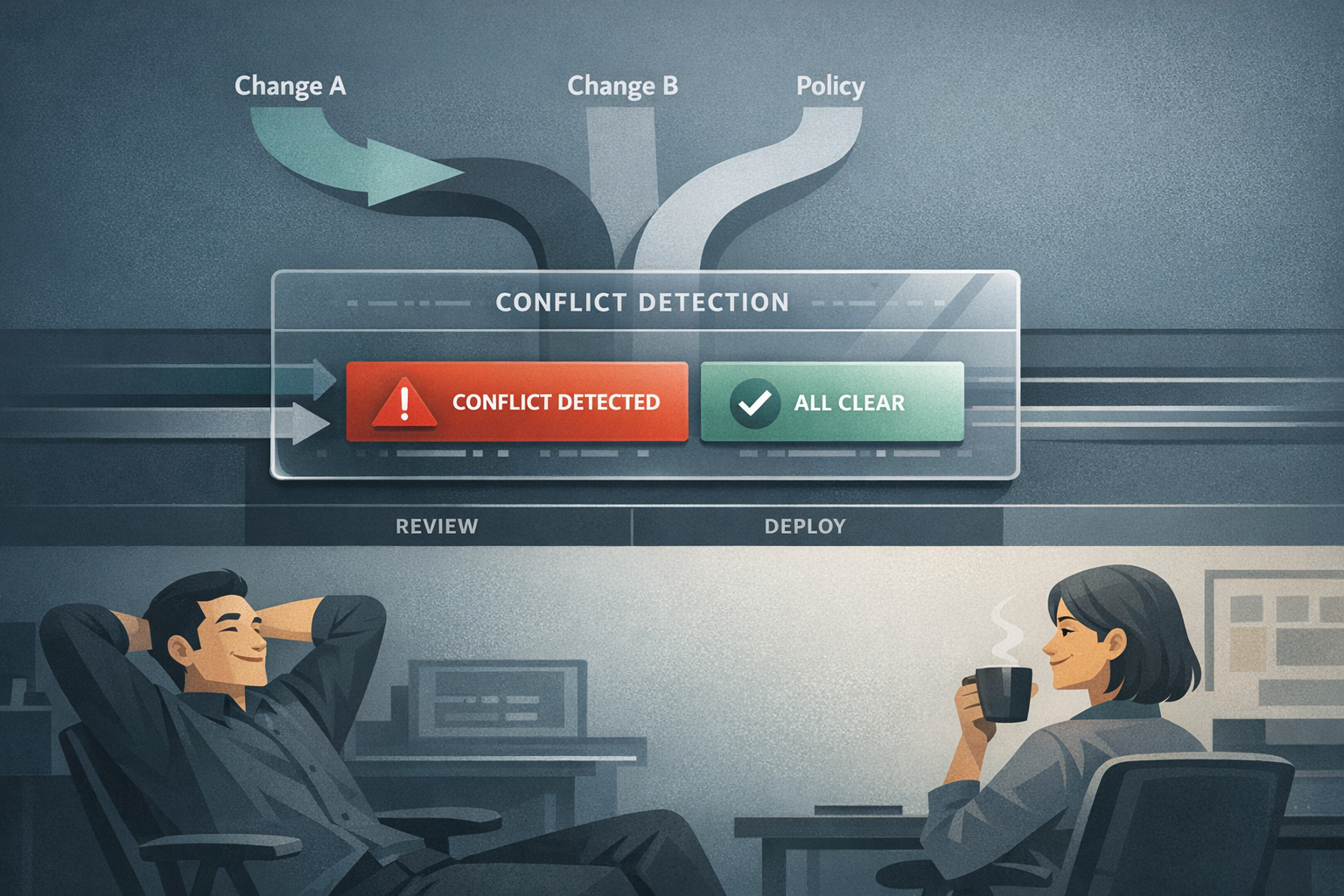
For CTOs, the key issue is not whether a model can notice an inconsistency. It is whether the system can answer three harder questions when it matters:
- why did this alert appear,
- what evidence was compared,
- what happened when no alert was shown.
That is the difference between a useful risk system and a black-box novelty feature.
The more durable architecture is to treat conflict detection as a data pipeline with an adjudication step, not as a single LLM judgment over loose project memory.
If you want the shorter framing of this topic, start with Designing Conflict Detection as a Risk Signal. This post focuses on the deeper system design behind that posture.
Short version: if the detector can only say “trust me,” it has already lost half the argument.
The failure mode: one model call on weakly selected context
Naive conflict detection usually breaks in one of four ways.
1) It selects the wrong things to compare
In real delivery work, conflicts are rarely simple factual opposites.
They are more often mismatches like:
- a new request colliding with a prior scope boundary,
- a feature plan conflicting with a standing constraint,
- a commitment colliding with capacity,
- a newer action reopening an earlier decision.
If the system only compares “recently related” text, it often never assembles the right pair in the first place.
2) It reasons over paraphrases instead of source events
If an extractor has already compressed a meeting, document, or message into a short memory summary, the critical edge of the conflict may already be gone.
That means the detector is not really checking the event. It is checking a paraphrase of the event.
3) It cannot explain misses
If the system fails to surface something important, you need to know where the failure occurred:
- no structured claim extracted,
- no candidate pair generated,
- adjudication false negative,
- delivery suppression,
- thresholding or cap logic.
If everything is collapsed into one model call, you cannot separate those causes.
4) Delivery policy gets confused with detector truth
This is the biggest architectural mistake.
If the only persistent artifact is the user-facing alert, then “no alert” becomes ambiguous. It might mean:
- no issue existed,
- an issue was considered and rejected,
- an issue was found but not delivered,
- the system never compared the right evidence.
Those are operationally different states. The architecture should preserve that difference.
A better model: conflict detection as two-stage reasoning
The design pattern that works better is straightforward:
- generate plausible conflict candidates from structured project data
- adjudicate those candidates narrowly
flowchart LR
  Source[Project events and sources] --> Claims[Structured claims]
  Claims --> Candidates[Candidate generation]
  Candidates --> Judge[Narrow adjudication]
  Judge --> Findings[Durable findings]
  Findings --> Delivery[Optional alert delivery]
That sounds conservative, and it is. But conservative is not the same thing as weak. It is the architectural move that makes the system debuggable.
One-shot detector vs staged detector
| Concern | One-shot contradiction check | Staged detector |
|---|---|---|
| What gets compared? | Loosely selected context | Explicit candidate pairs |
| Evidence quality | Often paraphrased or mixed | Source-backed and narrower |
| Debuggability | Weak | Stronger |
| Delivery vs truth | Usually collapsed together | Separated |
| Tuning path | Mostly prompt tweaking | Prompt + data + pairing + delivery tuning |
Stage 1: generate candidate pairs structurally
The first job is not to prove a conflict. It is to answer:
Which newer project events or claims are plausibly incompatible with earlier ones?
This stage benefits from structured representations rather than free-form memory text.
The useful units are not just “memories.” They are smaller conflict-shaped claims with fields like:
- the affected subject,
- the state or action,
- the kind of claim,
- provenance to the originating source,
- optional timing and authority signals,
- a compact semantic representation for fuzzy matching.
Once you have that shape, candidate generation can use layered logic instead of vague semantic proximity.
Typical signals include:
- same or overlapping subject,
- matching resolved entities,
- semantic similarity over normalized claim text,
- temporal ordering,
- special-case patterns such as descoped-vs-requested or frozen-vs-modified.
That is important because a reliable detector is often won or lost in candidate generation, not in the LLM call that comes after.
Why structured claims matter more than people expect
Many teams assume the hard part of conflict detection is language understanding. In practice, one of the harder parts is normalization.
A system can only compare what it has made legible.
That means useful conflict detection often depends on deriving a structured layer over raw project inputs rather than asking the model to rediscover the same semantics from scratch every time.
This is the engineering value of structured claims:
- they make matching cheaper,
- they make reasoning narrower,
- they make storage and replay possible,
- they preserve provenance,
- they let the system compare the right kinds of things.
This is also why evidence-backed verification benchmarks such as FEVER are more relevant to system design than generic contradiction demos: they force you to care about the relationship between a claim and its supporting evidence, not just whether a model can sound plausible.
Stage 2: adjudicate narrowly, not globally
Once the system has candidate pairs, the LLM’s job becomes much smaller and better defined.
It is not scanning project history. It is adjudicating a focused packet containing:
- the newer structured claim,
- the prior structured claim,
- source excerpts for both sides,
- supporting project context if needed,
- candidate-generation reasons.
That architecture changes the role of the model. Instead of asking the model to discover the conflict across a noisy dataset, you are asking it to judge a bounded dispute packet.
Where misses can happen
| Stage | Example miss |
|---|---|
| Claim extraction | Important constraint never becomes structured input |
| Candidate generation | Gold pair is never assembled |
| Adjudication | Evidence is present, but judgment is wrong |
| Delivery | Valid finding is suppressed by policy |
Why negative findings matter: a durable “no conflict” result is still useful system state. It tells you the pair was considered, the detector was functioning, and the system did not simply miss the comparison altogether.
The most important design rule: findings first, alerts second
This is the architectural boundary that matters most.
The detector’s canonical output should be a durable finding, not a user-facing alert.
That finding can be positive or negative. It can carry:
- the evidence pair,
- the adjudication result,
- the conflict type,
- the severity,
- the rationale,
- the model used,
- the recommendation.
Only after that should the system decide whether to surface something in the product.
Why? Because delivery rules are a different concern entirely.
A system may choose not to alert because:
- the finding is low confidence,
- the issue is below a delivery threshold,
- a daily cap applies,
- a dedupe rule suppresses it,
- the current user should not see it.
None of those reasons should erase the detector’s actual conclusion.
Once you separate detector truth from delivery policy, you gain several things at once:
- cleaner evaluation,
- better auditability,
- easier tuning,
- fewer false assumptions about system behavior.
This same separation shows up in other trustworthy AI workflows too, including documentation generation, where draft synthesis and published truth should never be treated as the same thing.
Trust comes from diagnosability, not bravado
Conflict detection for project work should not promise omniscience.
That is especially true in systems where conflicts are shaped by:
- authority,
- project scope,
- sequencing,
- capacity,
- changing business decisions.
The better posture is not “we automatically prevent contradictions.” It is closer to this:
- we surface review-worthy risks,
- we preserve evidence,
- we separate findings from delivery,
- we let the system improve through analysis of misses.
That is also why broader risk-management guidance such as the NIST AI RMF and Generative AI Profile is useful here: the hard part is not only model behavior, but how the surrounding system handles uncertainty, evidence, and operator judgment.
The broader lesson for AI systems
This design pattern generalizes beyond conflict detection.
Whenever an AI system is expected to raise important product signals, ask three questions:
- What is the structured intermediate representation?
- What is the durable detector output?
- What part is product delivery policy rather than model judgment?
If you cannot answer those cleanly, you probably do not have an operationally trustworthy signal yet.
That is why the right way to think about conflict detection is not “add an LLM contradiction checker.” It is a legible pipeline that turns messy project inputs into structured comparisons, narrow adjudications, and reviewable findings.
The same argument shows up in retrieval architecture, where the quality of the system depends as much on legible intermediate stages as on the final model output.
Closing thought
The hard part of conflict detection is not getting a model to say “these two things look inconsistent.”
The hard part is building a system where people can trust what happened before and after that sentence was generated.
That usually means less magic and more structure:
- structured claims,
- deterministic candidate generation,
- narrow adjudication,
- durable findings,
- separate delivery logic.
In other words: not just a prompt, but an architecture.