One of the easiest ways to damage trust in an AI product is to let it sound more certain than the system actually is.
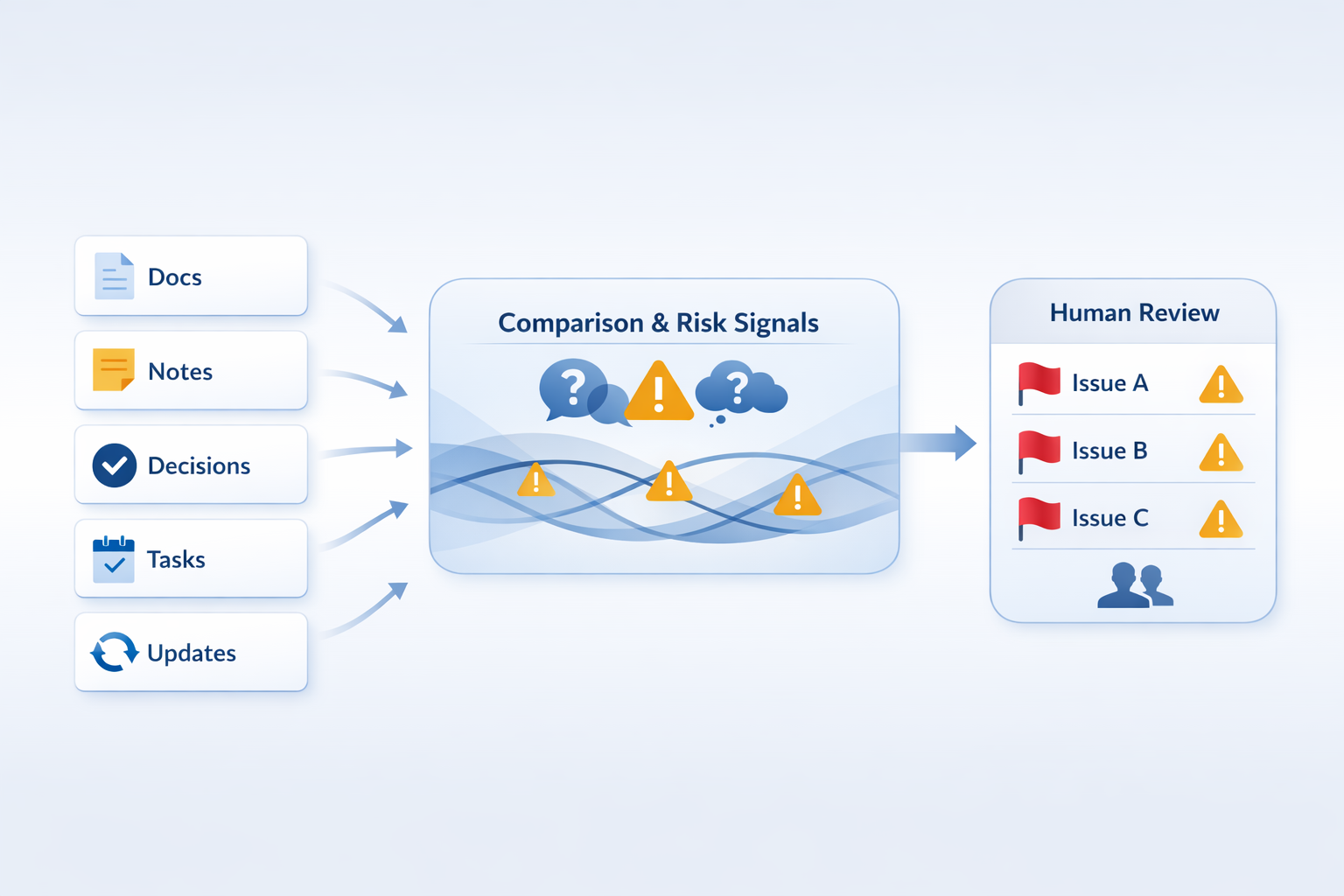
Accord Book's conflict-detection docs avoid that trap. The feature is positioned as a conservative risk signal for owner review, not as an automatic truth machine. That is the right posture for real project work.
Conflicts in software delivery are rarely clean logical contradictions. They often involve scope, constraints, authority, capacity, timing, or commitments made in different places by different people. A new request may not be false; it may simply be incompatible with an earlier decision.
The docs make two useful points here. First, conflict detection has to be grounded in provenance, because the user needs to inspect both sides of the mismatch. Second, the system should store durable findings before delivery logic, so teams can distinguish between no finding and an unsurfaced finding.
The architectural response is a two-stage design: candidate generation from canonical project data, then narrower adjudication over plausible pairs. That is more disciplined than asking a model to scan a loose pile of memory and declare contradictions directly.
That posture works best when the signal is framed clearly:
| Signal type | What it indicates | Why human review still matters |
|---|---|---|
| Scope mismatch | New request may exceed prior agreement | Business context may have changed |
| Constraint violation | Proposed work may collide with a standing limit | Severity and workaround cost are contextual |
| Decision drift | Team may be acting against a prior choice | Newer approval may exist elsewhere |
| Temporal staleness | A relied-on fact may no longer be current | Someone must confirm what is now authoritative |
Just as important is what the system does not claim. The docs explicitly avoid promising exhaustive coverage or automatic prevention of all conflicts. In software delivery, a review-worthy signal with evidence is usually more valuable than a louder system pretending to be definitive.
Further reading